
Views: 0 Author: Site Editor Publish Time: 2026-09-07 Origin: Site


When a top drive is down, the urgent question is usually simple: how quickly can the correct part reach the rig? The difficult part is the word “correct.” A familiar description or a similar-looking component does not always confirm fit, especially when equipment has been upgraded, repaired, or modified during its service life.
JJC TEC supplies NOV top drive spare parts and supports maintenance teams with part identification, sourcing, workshop overhaul, testing, and technical review. Our work covers commonly used TDS models, including TDS-11SA, TDS-8SA, TDS-4SA, TDS-10SA, TDS-11H, and TDS-9SA.
This article explains what buyers should provide with an enquiry, which spare-part categories require the closest verification, and how parts supply connects with practical overhaul experience.
A top drive combines high-load mechanical systems, hydraulics, controls, lubrication, cooling, and the drilling-fluid path. A single RFQ may therefore include several very different types of components.
Typical enquiries handled by JJC TEC include:
Washpipe assemblies and washpipe packing
S-pipes and goosenecks
Upper and lower IBOP-related parts
Bail pins, bushings, and retaining parts
Cylinders, seal kits, hoses, and fittings
Hydraulic pumps, motors, valves, and manifold assemblies
Lube pump assemblies and filtration components
Motor cooling fans and blowers
Pipe-handler and torque-wrench components
RLA stems, gears, shot-pin assemblies, and related wear parts
Bearings, seals, fasteners, and selected gearbox components
Sensors, connectors, switches, cables, and other electrical items
The exact supply scope depends on the model, serial number, part number, revision, and installed configuration. For this reason, JJC TEC reviews the available identification information before confirming a quotation.
Buyers who already have a list can also compare it with our NOV spare-parts reference page or send the complete spreadsheet for review.
Top drive components are not reliably selected by appearance alone. Two parts may look almost identical while differing in pressure rating, connection, material, dimensions, electrical interface, or revision.
The risk increases when an RFQ contains only descriptions such as “seal,” “hydraulic valve,” or “sensor.” Even when a part number is supplied, it should be checked against the equipment information available.
Before requesting a quotation, prepare as many of the following details as possible:
Top drive model
Equipment serial number
Part number and revision
Description from the manual or bill of materials
Required quantity
Clear photographs of the part and nameplate
Connector, port, or mounting details where relevant
Destination country and required delivery date
Required inspection records or certificates
Whether the removed part is available for comparison
A clear RFQ reduces repeated emails and helps purchasing, engineering, and logistics work from the same technical scope.
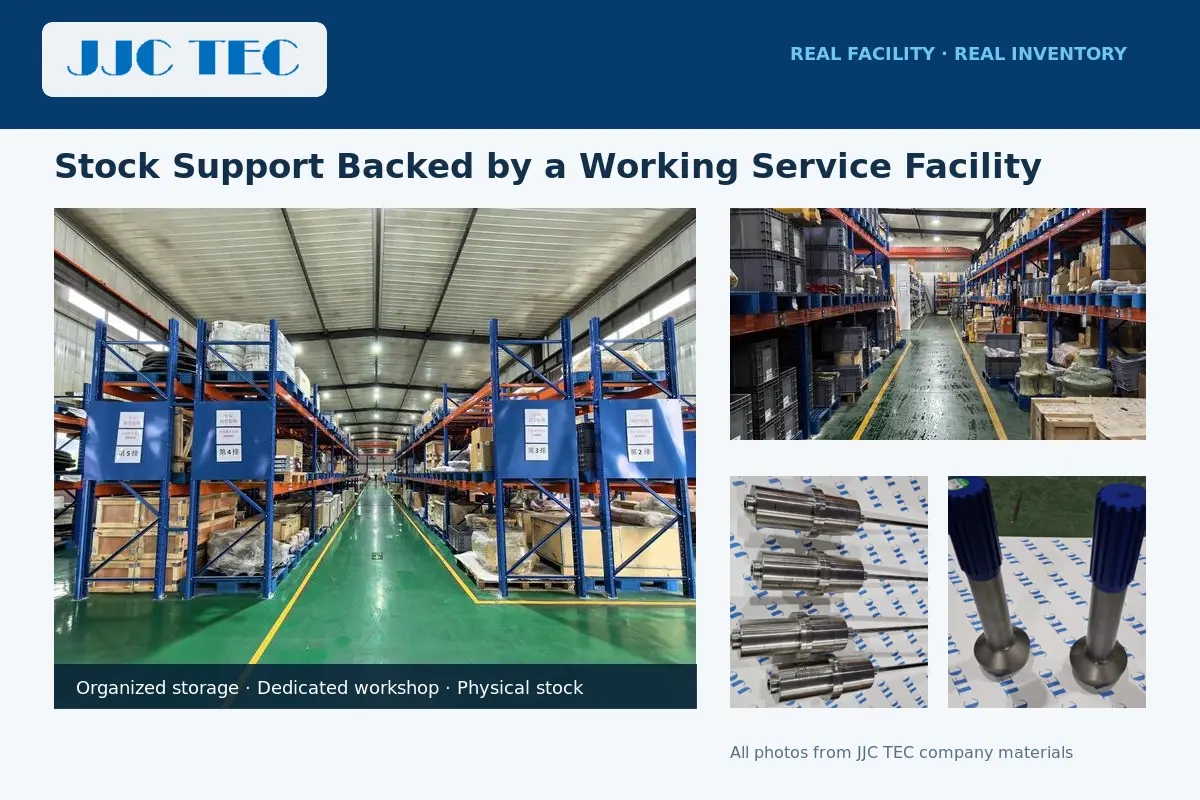
JJC TEC’s spare-parts service is connected to its drilling-equipment technical-service business. This matters because a part is often easier to evaluate when the supplier understands where it is installed, how it works, and what is normally inspected around it.
Our company brochure documents:
A technical team with more than 20 experts and experienced field engineers
24/7 on-site and remote support for drilling packages, individual equipment, hardware, and control systems
Service experience covering more than 50 offshore platforms
In-house spare-parts support and short-lead-time sourcing capability
Stock of regular repair items, with same-day dispatch available for stocked parts
Service stations and spare-parts inventory supporting customers in major oil regions
Availability remains part-specific. We confirm stock and lead time against each enquiry rather than applying one delivery promise to every item.
The workshop and warehouse photographs used on this page are from JJC TEC facilities. They show organized storage, dedicated work areas, lifting equipment, and the physical environment behind our supply and repair activities.
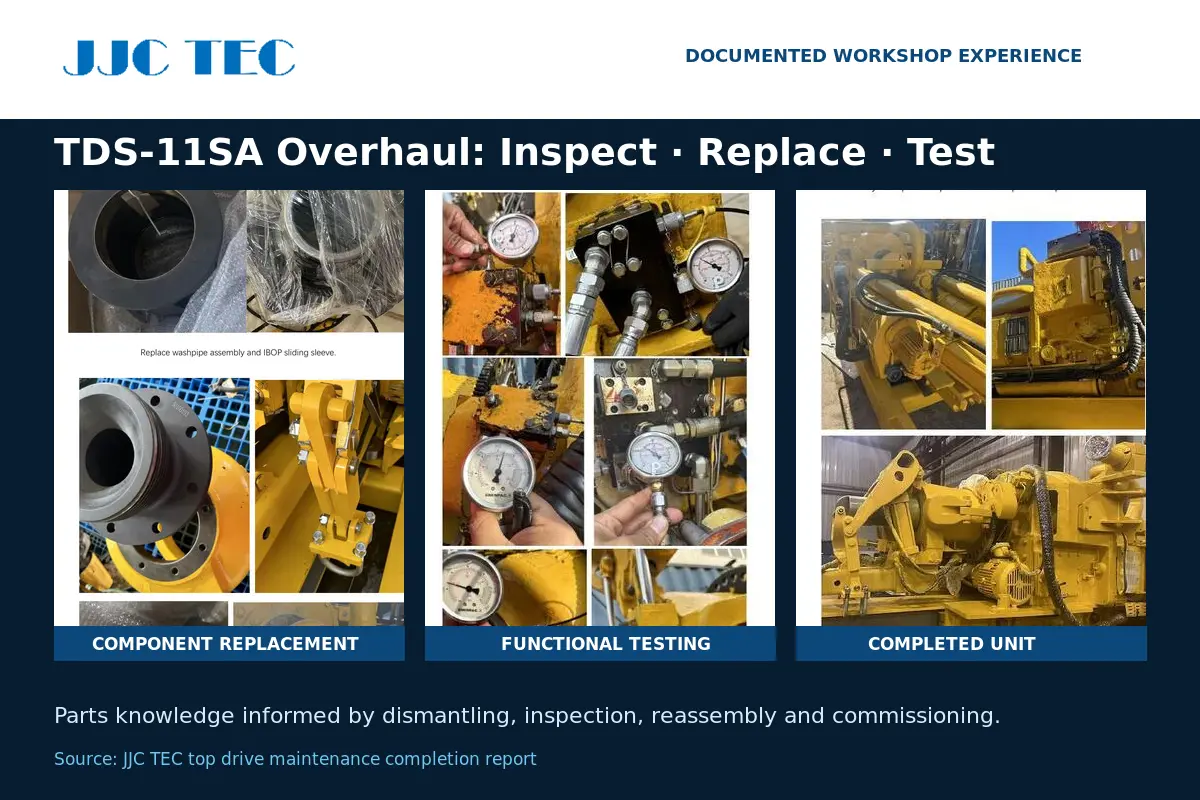
A parts list tells the purchasing team what to buy. An overhaul reveals why those parts are needed and which surrounding components should also be checked.
In a documented TDS-11SA workshop project, JJC TEC dismantled, cleaned, inspected, repaired, reassembled, and function-tested a top drive that had been in long-term service. The work included mechanical, hydraulic, electrical, lubrication, and drilling-fluid-path items.
Examples recorded in the completion report included:
Replacement of a washpipe assembly and IBOP sliding sleeve
Renewal of heavily corroded connecting pipework
Replacement of bushings, bearings, seals, gears, and selected motors
Repair and reassembly of the gear-oil pump and lock-pin assemblies
Replacement of pipelines, vulnerable bolts, and related service parts
Inspection and adjustment of spindle runout, flatness, and coaxiality
Hydraulic pressure calibration and functional commissioning
Electrical signal, motor-current, temperature-rise, and rotation checks
After powered testing, hydraulic movements and pressures were recorded within the required range; encoder and pressure-switch signals functioned correctly; the spindle rotated smoothly without abnormal noise; and the completed unit was accepted for the stated platform repair requirements.
This case is useful for buyers because it shows that top drive spare-parts planning is rarely limited to one visible failed component. Inspection may uncover worn bushings, damaged seals, corroded lines, missing fasteners, or related parts that affect reassembly and commissioning.
Not every spare should be managed in the same way. A practical list separates routine consumption from items that can stop the rig.
These may include seals, filters, packing elements, O-rings, selected hoses, fittings, and fasteners. They are usually planned around maintenance tasks and historical usage.
These are items whose failure can stop the top drive or significantly restrict drilling. The correct list depends on the installed unit, operating environment, local repair capability, and replenishment time.
These items are ordered for a defined workshop scope or after dismantling and measurement. Bearings, bushings, gears, shafts, pipe-handler components, and major assemblies often fall into this group.
For remote or offshore rigs, logistics risk should be considered alongside part value. A low-cost component can still create costly downtime if it is unavailable at the point of maintenance.
For an efficient review, send one consolidated parts list instead of separate descriptions across multiple messages. A spreadsheet can include:
| Item | Part Number | Description | Qty. | Top Drive Model | Serial Number | Required Date | Photo Reference |
|---|---|---|---|---|---|---|---|
| 1 | Available number | Manual description | Required qty. | TDS model | If available | Target date | File name |
Our review normally follows four practical steps:
Check identification information. We compare the part number, description, model, serial information, and photographs provided.
Clarify the supply boundary. We confirm whether the request is for an individual item, repair kit, subassembly, or complete assembly.
Confirm availability and documentation. Stock status, lead time, condition, inspection requirements, and requested records are addressed item by item.
Prepare the quotation. Exceptions and points requiring confirmation are stated instead of being hidden behind a general description.
Where interchangeability or an alternative supply is proposed, the technical basis should be reviewed for the specific equipment before installation.
A useful supplier does more than return a price. Look for evidence that the company understands both the component and the maintenance context.
Questions worth asking include:
Does the supplier request the model and serial number?
Is the quoted part number clearly shown?
Are new, repaired, remanufactured, and alternative items identified accurately?
Is the quotation for a single part, a kit, or a complete assembly?
Are lead time and shipping time stated separately?
Can packaging, inspection, and documentation requirements be agreed before shipment?
Can the supplier support troubleshooting or overhaul if the issue is wider than one component?
Be cautious when every item is confirmed immediately despite incomplete identification information. In top drive maintenance, responsible clarification is part of the service.
If you are preparing routine stock, responding to a breakdown, or planning a top drive overhaul, send JJC TEC the available parts list and equipment information.
For the fastest review, include:
Top drive model and serial number
Part numbers and quantities
Nameplate and component photographs
Destination and required date
Any inspection or documentation requirements
Contact JJC TEC or email sales@jjcpe.com. You can also review our NOV top drive parts page and top drive overhaul and upgrade service.
JJC TEC handles enquiries for commonly used models including TDS-11SA, TDS-8SA, TDS-4SA, TDS-10SA, TDS-11H, and TDS-9SA. Final parts confirmation depends on the specific model, serial number, and configuration.
Provide the top drive model, serial number, part number, description, quantity, photographs, destination, required date, and documentation requirements whenever available.
JJC TEC can review photographs, labels, installation position, dimensions, and available equipment information. Additional inspection or clarification may be required before the item can be confirmed.
Yes. JJC TEC provides on-site inspection and repair as well as workshop overhaul for top drives and other critical drilling equipment. Service scope should be confirmed for each project.
No. Selected regular repair parts may be dispatched the same day when they are in stock. Availability and lead time are confirmed item by item.
NOV, VARCO, and related product names are trademarks of their respective owners. References are used solely to identify equipment and parts requirements. JJC TEC is not affiliated with or endorsed by NOV unless expressly stated otherwise.


